Swept sine, not pink noise
An exponential sweep yields arrival times — pink noise cannot. That is what makes aligning subs and tops possible at all.
PA tuning · Windows & Mac
AURIX runs a sine sweep through your own mic and works out what your PA is actually doing. You review every filter before anything is applied.
No credit card. Full version. The clock starts when you first launch it.
Windows 10/11 and macOS (Intel & Apple Silicon) · your existing audio interface · measurement mic required (not included)
The measurement
Every measurement gives you frequency response, delay and a confidence value. You tick off what gets applied.
These are the filters AURIX proposes from the measurement. Tap them — the curve responds immediately. This is exactly how you work in the software.
An exponential sweep yields arrival times — pink noise cannot. That is what makes aligning subs and tops possible at all.
Below the threshold AURIX refuses to generate filters instead of EQing noise. A dip from a reflection is not an EQ problem.
Delay in milliseconds, the matching distance, automatic polarity detection — and how certain the result is.
Who this is for
Fixed rig, never measured. One evening with a mic brings subs and tops together and puts the level ceiling where you want it.
New room every weekend. Set up, sweep, apply, play. Save the result per venue and recall it the next time you are there.
Speech intelligibility is the whole job. Measure, use the speech target curve, and keep a level ceiling that nobody can push past by accident.
How it works
Any measurement microphone on your interface. If you have a calibration file (REW format, as a UMIK-1 comes with), load it — otherwise included: Pioneer APM7008 and MCACC.
AURIX sets the measurement level itself from the mic headroom and noise floor, then sweeps subs and tops separately. Multiple mic positions get power-averaged.
Frequency response, proposed EQ bands, delay, polarity, crossover point, RT60 and the confidence score. Every item has its own checkbox.
Your audio runs through AURIX as the output device. Save the setup per venue and recall it later.
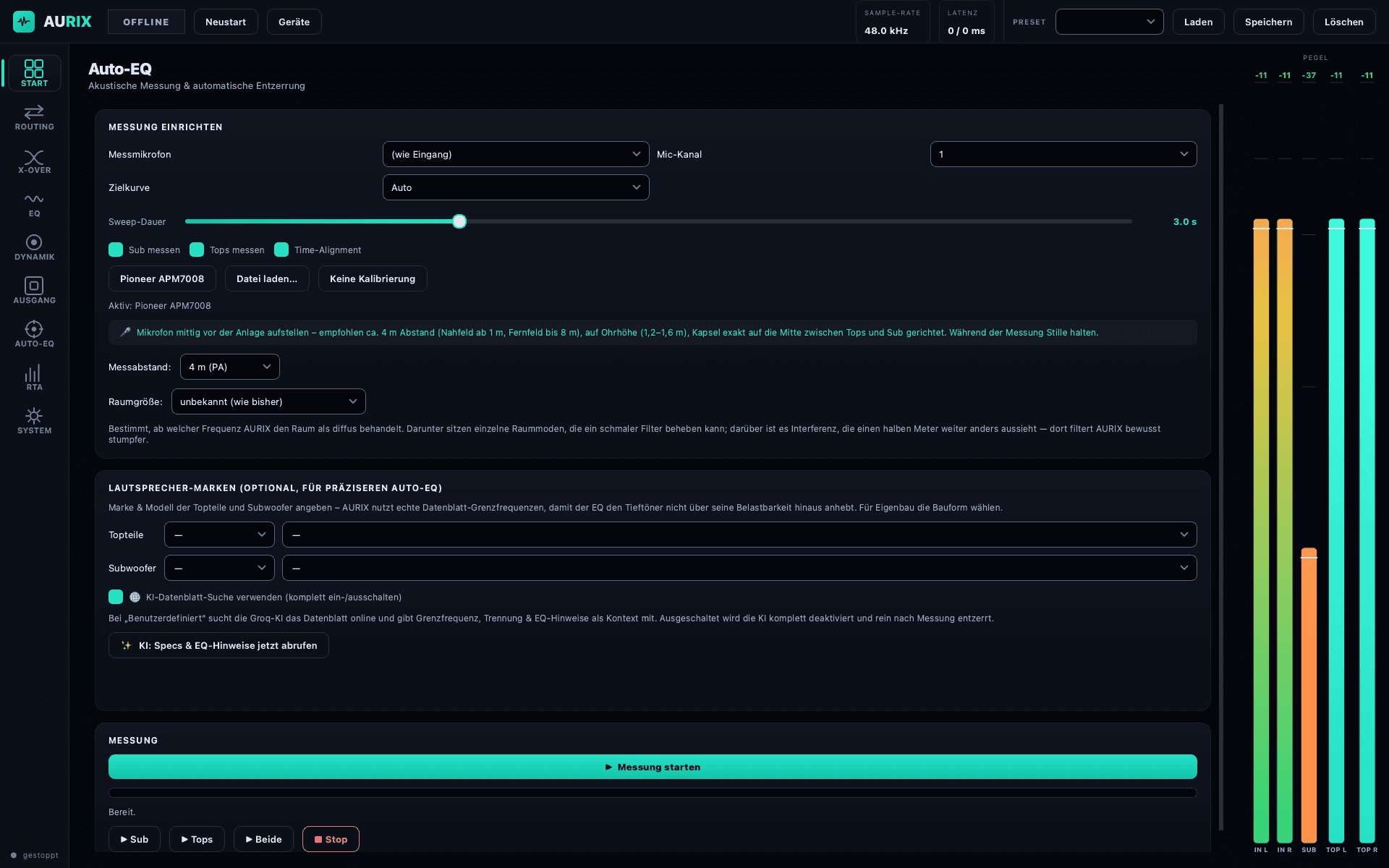
Measurement setup: mic and channel, target curve, sweep duration, calibration profile and measurement distance. Sub, tops and time alignment are selected separately.
Screen captures from the Windows application. The interface is German; see the specification table above.
Hearing protection (Levelizer)
Holds the A-weighted continuous sound level at the figure you set — even when someone else is at the desk.
The honest part
Everyone who has tuned a system has seen auto-EQ make things worse. Here is what AURIX does about each of the usual failure modes — and where it cannot help.
Fair. That is why AURIX shows every filter with its reason — and proposes nothing at all below the confidence threshold.
True — which is why a single position is not the default. Several positions are averaged and weighted by their spread.
No. AURIX proposes, you decide. Every filter can be switched off or edited by hand.
AURIX runs your audio through your interface. If the computer dies, there is silence — as with any computer in the signal path. For critical shows, keep a hardware path alongside.
Check it. Measure the same rig in REW or Smaart and compare — every parameter is on screen.
Then the measurement stays your tool: you see what the room does and decide yourself.
Specifications
Measurement mic — required, not included
Any measurement microphone on your audio interface. Calibration files in REW format can be loaded; two profiles are built in.
Windows 10 or 11 (64-bit) or macOS 11+ (Intel & Apple Silicon)
No macOS or Linux version. No dedicated hardware needed.
Your existing audio interface
AURIX becomes the output device. Two outputs for a sub/tops split.
Compared with
The tools people actually buy for this job, with prices for orientation. The rows where AURIX loses are in the table too.
| AURIX | Measurement suite + correction plug-in | Hardware processor | |
|---|---|---|---|
| Typical price | €99once | ≈ €800–900 | €120–600 |
| Swept-sine measurement | Yes | Yes | Partly |
| Automatic sub/top time alignment | Yes | Manual | Manual |
| Confidence score that can refuse to correct | Yes | No | No |
| Crossover up to 48 dB/oct | Yes | No | Yes |
| Calibrated SPL meter | Yes | Yes | Partly |
| Calibrated maximum-level ceiling | Yes | No | Partly |
| Tablet remote included | Yes | No | Varies |
| Runs without a laptop in the signal path | No | No | Yes |
| Analog inputs and outputs of its own | No | No | Yes |
| Runs on macOS | No | Yes | Varies |
Comparison figures are estimates for typical setups, not quotes.
Pricing
Includes every update. No subscription, no dongle, no online check each time you open it.
€99once
perpetual licence · 3 activations · updates included
Try free for 7 daysBuy30-day money-back guarantee — write to us and you get a refund, no questions asked.
The statutory right of withdrawal for digital goods lapses once the download begins. The guarantee above is ours, given voluntarily, and applies regardless.
Who is behind this
AURIX is built in Germany by someone who tunes PA systems himself. No subscription, no account required to run it.
Measure the same system in REW or Smaart and compare our result. If it disagrees, tell us — that is the most useful message you can send.
A measurement mic, an audio interface and a computer. We supply none of them.
To process audio, yes. The signal comes in through your interface — or, if you want to process the computer's own audio, through a virtual audio device (Windows: VB-CABLE, macOS: BlackHole) that AURIX points you to. Measuring alone works too; you then transfer the values to your rack by hand.
Three activations per licence. You can release a device in your account at any time, so replacing a laptop is not a problem.
The software then asks for a licence again. Your measurements, filters and setups stay on your computer — after you buy, everything is right where you left it.
Only for activation. After that the licence is verified locally, so the software keeps working without a connection and checks in when it can.
Yes. AURIX runs on Windows and on macOS 11 or newer — on Intel Macs and, since version 1.6.2, as a native build for Apple Silicon (M1 and newer). Both Mac builds are listed separately in your account. The licence covers both systems and you can spread your three devices freely. Two things up front: the Mac build is not registered with Apple, so macOS asks once on first launch (right-click → Open), and the interface is currently German-only on both systems.
Yes, 30 days, no questions asked. One message is enough.
No, and we do not claim it does. AURIX holds the A-weighted continuous level at the figure you set, caps the C-weighted peak and shows both over 15 or 30 minutes. Regulations such as DIN 15905-5 additionally require a Leq log and a sealed limiter from an approved body — AURIX replaces neither. Nor is it a certified measuring instrument.
Questions from the field: Knowledge
Seven days, the full version, no card. If the result does not convince you, you have lost nothing but an evening — and you will know more about your PA than you did before.
The trial is tracked against the latest date the software has seen. Setting the system clock back ends the trial rather than extending it.
Windows 10/11 and macOS (Intel & Apple Silicon) · updates included


